
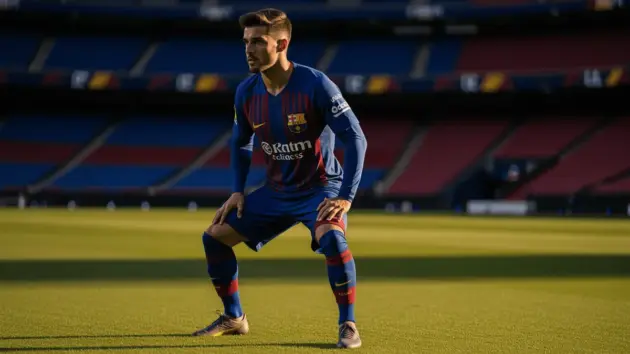
FC Barcelona’s defensive planning for the seasons ahead has carried an uncomfortable asterisk ever since Andreas Christensen’s knee problems began to accumulate, and the question of whether the club would retain him on revised terms or allow his existing deal to expire in June 2026 has hovered over the sporting department’s centre-back decisions for the better part of a year. That uncertainty has now been resolved – at least on paper – with the Blaugranes confirming a contract extension that keeps Christensen at the club beyond his original agreement, though the structure of the deal reflects precisely how seriously Barcelona are treating the fitness risk that has defined much of his time in Catalonia. As was reported here when renewal talks began gaining traction, the club’s willingness to extend was always contingent on finding contractual protections that matched the medical uncertainty.
As Samuel Marsden has reported, Christensen has signed a two-year extension that ties him to FC Barcelona until June 30, 2028, with a mutual option allowing either party to cancel the second year after the 2026–27 season concludes. Critically, multiple reports – including La Vanguardia and Elbotola – indicate that the deal contains a participation-based termination clause: if Christensen falls below approximately 30 percent of available matches during the first season of the extension, Barcelona retain the right to activate an exit mechanism before the second year comes into effect. On the financial side, he has accepted a salary reduction of roughly 50 percent, with his gross annual earnings dropping from around €12 million to a fixed figure closer to €5–6 million, with performance-related bonuses based on minutes and appearances potentially lifting his total to €8–9 million – still materially below his previous level.
At 29 years of age, Christensen arrived at Barcelona from Chelsea on a free transfer in July 2022, signing an initial contract to June 30, 2026 with a €500 million buyout clause. A left-footed ball-playing centre-back, he established himself as a starter under Xavi in his early seasons and demonstrated the technical profile and positional intelligence that the Blaugrana’s high defensive line demands – qualities Hansi Flick values equally highly, as the German coach made clear in his comments on Christensen’s situation ahead of the Betis fixture. The difficulty is that his output has been severely curtailed by injury, with a serious knee problem accounting for much of his absence; across the last two seasons combined, he has managed approximately 23 appearances, a figure that underlines why the renewal was never straightforward and why the extension’s architecture is built the way it is.
The participation clause is not a minor administrative detail – it is the structural load-bearing element of the entire arrangement. If Christensen cannot reach the 30 percent appearance threshold during 2025–26, the club’s exposure is limited to a single season at a significantly reduced salary, which represents a manageable risk relative to losing an experienced, technically accomplished centre-back for nothing. What the clause also signals is that Barcelona cannot treat Christensen as a guaranteed presence in their defensive rotation when planning squad registration or assessing cover requirements; his availability remains conditional rather than assumed, and the sporting department will need to factor that into any decisions about centre-back depth for next summer. The pay cut, structured around bonuses tied to participation, reinforces the same logic: the club has shifted a portion of the financial risk onto performance rather than absorbing it unconditionally.
The extension, framed this way, does not reduce the urgency of Barcelona’s wider defensive recruitment as much as it might appear to at first glance. With Christensen’s effective availability still uncertain, Deco’s department continues to track centre-back profiles capable of providing genuine cover, and the reported interest in RB Leipzig’s Castello Lukeba points to a parallel operation that would address the depth question regardless of how Christensen’s knee responds. What the renewal does provide is an experienced, technically superior fallback option retained at a cost the club’s current wage framework can accommodate – one that, according to multiple reports, Christensen chose over more lucrative offers from clubs in Europe and the Middle East, accepting reduced terms to remain at the Camp Nou.
The restructured contract represents a genuine opportunity for Christensen to remind everyone — Flick, the club, and the Camp Nou — exactly what he is capable of when fit. His technical quality has never been in question, and with the pressure of a heavy wage commitment lifted from both sides, there is every reason to believe he can rediscover the consistency and physical durability that made him one of the most coveted free transfers in recent memory. If his knee holds, Barcelona will have a world-class centre-back contributing across both seasons of the extension — and that, for a deal structured around so much caution, would be a very welcome outcome indeed.